
‘Rare’ is a four-letter word that affects the entire family
Raising a medically complex child means missing special family events
Written by |

My son Hollis is a medically complex child, but I’m also the mother of four other children. Hollis has three older sisters — Haylie, Hope, and Haven — and an older brother, Hector Jr. Together, we’ve all been beside him every step of the way medically, emotionally, and physically.
Parenting a child with multiple rare diseases while raising four other children is challenging. When one child experiences a medical emergency, the entire family feels it.
After a difficult 2025, we entered this year hoping for normalcy. Hollis had spent his 10th birthday hospitalized, and during another hospitalization over Valentine’s Day weekend, I learned how quickly vomiting from norovirus could become dangerous for a child with secondary adrenal insufficiency. Then Hollis turned 11 without being sick or hospitalized, which gave us hope.

A tough year continues
On Feb. 23, my oldest daughter Haylie’s 15th birthday, Hollis woke up with a 102-degree fever. New York was under a state of emergency because of a severe snowstorm, but Hollis needed medical care. There was so much snow that our building entrance had to be shoveled for emergency medical services to enter. Then the ambulance got stuck, and the EMS crew had to shovel a path so that we could leave.
At Jamaica Hospital, Hollis’ doctors consulted his endocrinology team at NewYork-Presbyterian/Columbia University Irving Medical Center about managing his secondary adrenal insufficiency. They decided his medical complexity warranted a transfer to NewYork-Presbyterian Morgan Stanley Children’s Hospital.
As soon as one of the EMS personnel saw Hollis, he said he looked familiar. We connected the dots: He was the same person who had transported Hollis to Morgan Stanley when his brain tumor was discovered at age 4. Now, at 11, Hollis was in his ambulance again. He was happy to see how much Hollis had grown, but saddened by how medically complex his life had become.
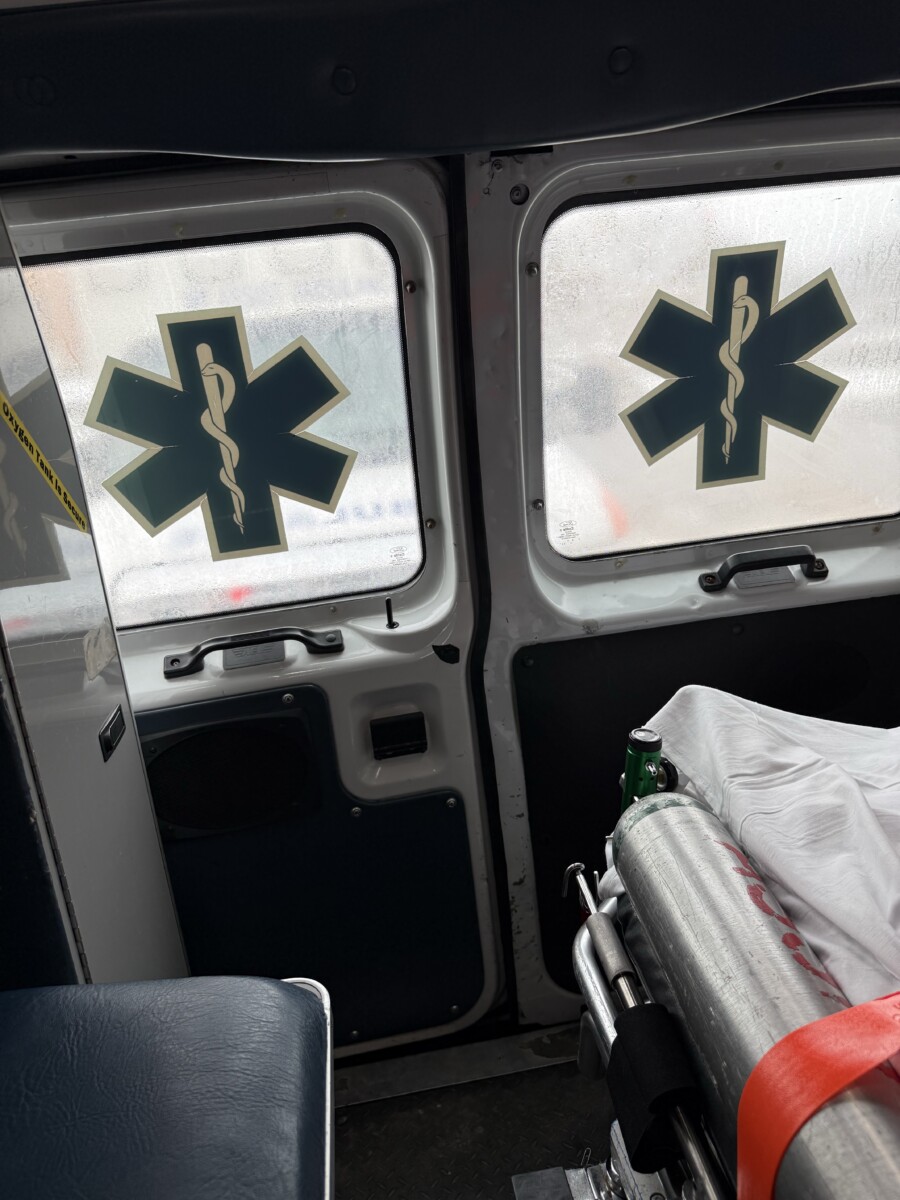
Hollis is transported to the hospital during a severe snowstorm earlier this year. (Photo by Sarah Horta)
By the time everything was over, I had missed Haylie’s 15th birthday. She understood, but as her mother, it hurt.
Four months later, June 18 brought another painful reminder of how one child’s medical condition affects everyone. It was Hope and Hector Jr.’s eighth-grade graduation. About two hours before the ceremony, Hollis’ school called to tell me he had experienced a seizure and was being taken to the hospital.
Hope was beside me. When I hung up, she said, “Well, I guess you’re going to miss my graduation.” I still hear the pain in her voice. She wasn’t angry with Hollis. She understood her brother needed me, but I’m her mother, too.
Hope walked across that stage without me. Knowing what our family was facing, her best friend’s mother cheered for her, hugged her, and made sure she felt special. But pictures and videos can’t replace being there. You only get one eighth-grade graduation.
Meanwhile, Hollis’ medical journey has continued to become more complicated. He continues to gain weight despite being treated for acquired hypothalamic obesity, which affects other aspects of his medical management. His treatment has also caused significant visible changes, including a darkening of his skin, while we wait to see what benefit it may provide.
Then came the biggest blow of 2026: After years of stability, imaging revealed a new discovery in his brain.
Most recently, Hollis was hospitalized for video electroencephalograph (EEG) monitoring at NewYork-Presbyterian Westchester. His EEG was abnormal, showing that the electrical activity in the back regions of his brain wasn’t functioning normally. His neurologist discussed these abnormalities in relation to the area being followed on his imaging. It is another piece of information his medical team now has to investigate.
This is why I say rare disease doesn’t happen to only one person. It happens when one sibling’s birthday becomes a hospital day, or another walks across a graduation stage without her mother. Siblings learn to understand seizures, adrenal crises, and sudden changes of plans.
We won’t get Haylie’s 15th birthday back. We won’t get Hope and Hector Jr.’s eighth-grade graduation back. I carry grief over those missed moments while also having the greatest silver lining of all: Their brother is still here. My son is still here.
Rare is only a four-letter word, but living rare touches an entire family. There is so much more I want to share about the challenges our family faces and how acquired hypothalamic obesity intersects with an already medically complex life.
Get comfortable. I’ll see you back here next week.
Note: Rare Obesity News is strictly a news and information website about these disorders. It does not provide medical advice, diagnosis, or treatment. This content is not intended to be a substitute for professional medical advice, diagnosis, or treatment. Always seek the advice of your physician or another qualified health provider with any questions you may have regarding a medical condition. Never disregard professional medical advice or delay in seeking it because of something you have read on this website. The opinions expressed in this column are not those of Rare Obesity News or its parent company, Bionews, and are intended to spark discussion about issues pertaining to rare obesity disorders.
