
Bardet-Biedl syndrome symptoms
 Fact-checked by
 There are many possible symptoms of Bardet-Biedl syndrome (BBS), a rare multisystemic condition that’s usually evident in infancy or early childhood. While there are certain core BBS symptoms seen in most patients, the disease course, including specific symptoms, timeline, and severity, can vary.
BBS is a genetic ciliopathy, meaning it disrupts cellular structures called cilia that perform a variety of functions throughout the body. Early signs of BBS, detected before or at birth, may include extra fingers or toes and differences in kidney or genital structure. As people with BBS get older, they may develop obesity, vision problems, learning disabilities, and other symptoms.
Several genetic mutations can cause BBS, and genetic variation may explain some differences in symptoms. For example, people with mutations in the BBS1 gene may be less likely than those with BBS2 mutations to experience kidney problems and have extra fingers or toes. However, the correlation between genetics and symptoms isn’t entirely clear.
Symptom awareness and monitoring can help both doctors and patients track disease progression and prevent or manage complications.
Common symptoms
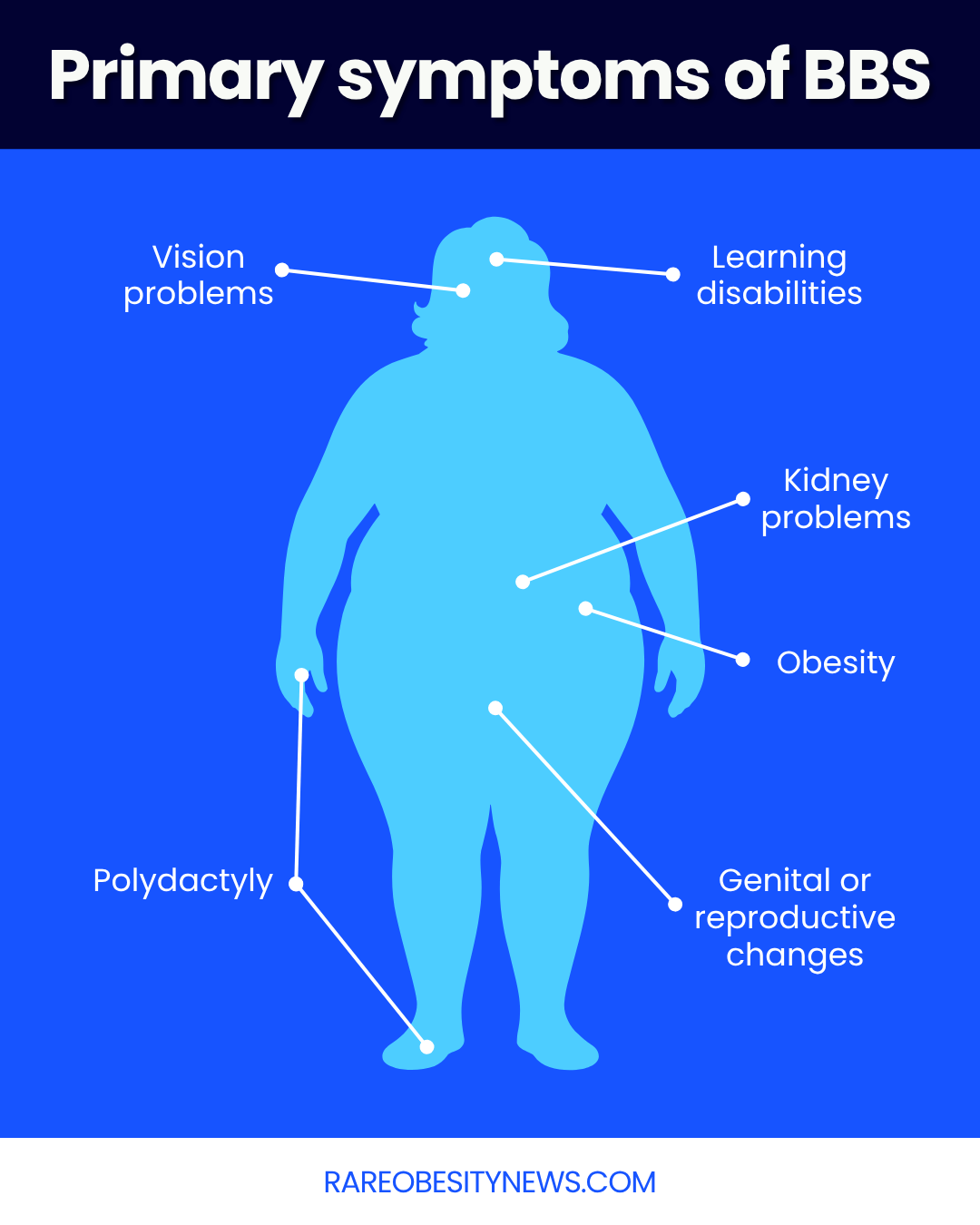
There are six cardinal clinical features of BBS:
- truncal obesity: carrying excessive weight around the middle part of the body (abdomen and chest)
- retinal degeneration: damage to the retina, a light-sensitive area at the back of the eye, leading to vision problems
- polydactyly: additional fingers or toes at birth
- learning disabilities: cognitive and developmental delays, and intellectual disability
- renal anomalies: problems with kidney structure and function
- reproductive abnormalities: impaired sex hormone production (hypogonadism) and problems with the structure or function of the reproductive tract
Having at least four of these features, or three of them in addition to two secondary disease features, is typically sufficient for a diagnosis of BBS.
Truncal obesity
Obesity in BBS is related to problems with appetite regulation in the brain. As a result, many people with BBS experience excessive hunger (hyperphagia), which can lead to weight gain.
BBS obesity often begins in infancy or childhood. For children, weight gain may be distributed throughout the body, but for adults, it is usually truncal.
Retinal degeneration and other eye problems
BBS-related ciliopathy can lead to a pattern of retinal damage called rod-cone dystrophy, in which specialized light-sensing cells are progressively lost.
While the timeline of BBS vision changes can vary, they often begin in childhood with night blindness (nyctalopia), or difficulty seeing in low light.
Patients may experience peripheral vision loss, more commonly known as tunnel vision, in which the edges of the visual field are unclear. Eventually, many people with BBS also lose this central vision and become legally blind.
Other eye problems that can occur in BBS include:
- crossed eyes
- astigmatism, an irregularity in eye shape that affects vision
- cataracts, a clouding of the eye’s lens, which causes light sensitivity or vision changes
Polydactyly
People with BBS may be born with extra fingers or toes, which most often manifests as postaxial polydactyly, in which the added digits are next to the pinky finger or little toe. Extra toes are more common than extra fingers.
Fingers and toes may also be webbed, abnormally short, or fused together.
Learning disabilities
Learning disabilities in BBS are typically mild or moderate, though this can vary. Many children with BBS achieve basic skills on a normal or near-normal timeline, or experience some speech delays. Many children have difficulty with memorization.
Some learning challenges, like difficulty reading, may be related to vision problems, so eye tests are important.
Renal anomalies
Kidney problems in BBS can vary, but may include structural abnormalities, such as kidney enlargement or fluid-filled pouches (cysts), that are detected on ultrasounds before birth.
About half of children with BBS have normal or near-normal kidney function. More severe problems, including chronic kidney disease and kidney failure, can develop in some people throughout life.
Genital and reproductive tract abnormalities
Disrupted hormone production in BBS leads to hypogonadism. This commonly causes a small penis or testicles that don’t properly descend in males with BBS. In females, hypogonadism may cause structural abnormalities in the reproductive system and irregular menstrual cycles. These anomalies can delay puberty and affect fertility.
Some genital abnormalities may initially become apparent in fetal ultrasounds.
Other possible symptoms
In addition to the six key BBS symptoms, people with the disease may experience a wide range of other problems, including:
- metabolic disorders, such as diabetes or metabolic syndrome
- neurological issues, including behavioral and movement problems or sensory changes
- dental problems, including overlap or twisting of teeth as a result of dental crowding, missing teeth, or unusual tooth shape
- problems in the heart, such as abnormal heart structure at birth or heart valve problems
- liver problems
- gastrointestinal issues
- asthma
- skin problems
When metabolism — the process by which the body breaks down food for energy — is disturbed, it can lead to metabolic syndrome. This typically is marked by a cluster of symptoms that include abdominal obesity, high blood pressure, and abnormal blood levels of cholesterol, other fats, and sugar. Many people with BBS develop cardiovascular abnormalities, type 2 diabetes, or insulin resistance, where the body doesn’t respond well to the hormone that regulates blood sugar.
A wide range of neurological issues may occur in BBS, including hearing or smell loss, sleep disturbances, delayed motor skills, difficulty with balance or coordination, generalized cognitive impairment, and seizures. People with BBS may also have behavioral problems, including autism-like traits, hyperactivity, impulsivity, and issues with emotional control.
When do symptoms appear?
In general, certain BBS symptoms tend to emerge at different life stages:
- before birth: polydactyly, genital abnormalities, kidney structure problems
- infancy: kidney problems, excess appetite, and weight gain
- childhood: vision problems, learning disabilities, metabolic abnormalities
- adolescence: delayed puberty, altered or absent menstrual cycles
- adulthood: more profound vision loss or kidney disease, fertility problems
The precise timeline of symptoms varies between individuals, and not everyone with BBS will develop every symptom, or develop them at the same age. However, some ciliopathy symptoms, like extra fingers or toes, only develop before birth and can’t emerge later in life.
Symptoms in adults
Although BBS is usually diagnosed in childhood, symptoms persist into adulthood and may change throughout life. Adults with BBS often experience:
- worsening vision and kidney problems
- infertility
- difficulty with mobility, self-care, and performing everyday activities
- continued or worsening obesity
- metabolic syndrome, diabetes, fatty liver disease, or other complications of obesity
Although infertility or impaired fertility is common, both men and women with BBS can have biological children. Pregnancy may carry health risks for people with BBS, so close monitoring is vital.
Throughout life, follow-up care and monitoring are important for identifying and addressing potential complications of BBS.
When to call your doctor
Individuals with several characteristic symptoms of BBS should be seen by a doctor. One symptom alone isn’t necessarily cause for doctors to suspect BBS, although close monitoring may be warranted.
People with an established BBS diagnosis should alert their care team if they experience:
- vision changes
- symptoms of kidney failure, such as nausea, vomiting, changes in urination frequency, swelling, cramps, or dry and itchy skin
- symptoms of diabetes, such as frequent urination, increased hunger or thirst, unexpected weight loss, irritability, or frequent urinary tract infections
- symptoms of heart problems, such as chest pain, shortness of breath, or changes in heart rhythm
These changes can be serious or life-threatening and may require prompt intervention.
Doctors will likely recommend regular check-ups to monitor symptom changes and catch any complications early, if possible.
Rare Obesity News is strictly a news and information website about the disease. It does not provide medical advice, diagnosis, or treatment. This content is not intended to be a substitute for professional medical advice, diagnosis, or treatment. Always seek the advice of your physician or other qualified health provider with any questions you may have regarding a medical condition. Never disregard professional medical advice or delay in seeking it because of something you have read on this website.