
When raising a medically complex child, life can change in an instant
A typical school day turns into a nightmare for this columnist and mom
Written by |

Sometimes your day can start completely normally and change in a matter of hours.
Oct. 6 started like any other school day, except my 11-year-old son Hollis was especially excited to go back. He had missed school the day before for a neurology appointment, where we discussed his back and leg pain. Doctors had increased the dosage of one of his medications to help manage it.
But on that Tuesday morning, Hollis didn’t complain of pain or illness, and nothing indicated that he wasn’t feeling well. We woke up at 5:30 a.m., got him ready for the school bus, and he left, excited to see his friends.
That morning, I texted his school social worker with a bureaucratic request, and after running errands, I returned home around 1:40 p.m., made myself a cup of coffee, and planned to relax before preparing dinner. But five minutes later, my phone changed everything.
Hollis’ social worker texted that someone was going to call me. Because I had contacted her earlier, I assumed it was about that. Before I could respond, my phone rang. It was the director of Hollis’ school. His voice was serious. Hollis had collapsed, and an ambulance was on the way.
Panic immediately set in.

Emergencies don’t wait for you to prepare
I rushed to get dressed, but anxiety hit me so hard that my mind went blank. I had been to that hospital before and knew where it was, but I still found myself Googling the address and thinking, “Where am I going again?”
Hollis’ four siblings were still in school, dinner wasn’t made, Hollis had his weekly tutoring with the Pediatric Hope Project, and his home aide was supposed to arrive at 7 p.m. In minutes, our normal routine became things to cancel and rearrange while I tried to get to my child. I was terrified, but I had to keep myself together because my baby needed me.
His social worker stayed with him and kept me updated. Hollis had been playing basketball when he became pale and lightheaded. School staff had him sit down, and within seconds he collapsed and became unresponsive.
I later learned that he had been unconscious for about three to five minutes and there was some difficulty obtaining his blood pressure. By the time EMS workers arrived, Hollis was awake and alert.
This was already his second medical emergency since starting a new school in May. During the first one in June, he also lost consciousness.
Hollis was transported by ambulance to Northwell Greenwich Village Hospital in the West Village, Manhattan. Because he lives with secondary adrenal insufficiency following treatment for craniopharyngioma, he was given stress-dose hydrocortisone shortly after arriving. By the time I got there, he was awake, talking, and lying in a hospital bed with an IV in place and EKG stickers covering his chest.
Hours earlier, he had been excited about school. Now I was standing beside him wondering, “What is going on with my child?”
The emergency team ran tests, gave him IV fluids and pain medication, coordinated with his specialists at NewYork-Presbyterian Morgan Stanley Children’s Hospital in Washington Heights, and started antibiotics before his transfer there.
Hollis was then transported by ambulance. I watched him on the stretcher surrounded by monitors, IV tubing, and medical equipment, thinking about how quickly our ordinary Tuesday had disappeared.
The fear never dissipates
-
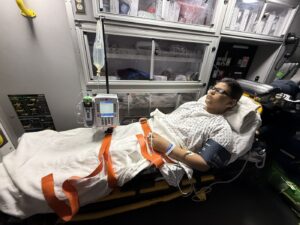
Hollis Horta, 11, is transported by ambulance from Northwell Greenwich Village Hospital in the West Village to NewYork-Presbyterian Morgan Stanley Children’s Hospital in Washington Heights, on Oct. 6. (Courtesy of Sarah Horta

At the children’s hospital, doctors continued evaluating his collapse. I was told there was concern for possible early sepsis. Cardiology also evaluated him because he had collapsed during physical activity. His EKGs were reassuring, but he needs further cardiac follow-up, including an echocardiogram, and cannot participate in strenuous physical activity until he is cleared.
Eventually, Hollis was stable enough to come home.
Just two days later, on Oct. 8, we marked seven years since Hollis was diagnosed with craniopharyngioma.
I cried. I was scared, hurt, and overwhelmed.
Sometimes everything can change in seconds. Hollis’ life changed seven years ago with his diagnosis, and on Oct. 6, our lives changed, again without warning.
When you raise a medically complex child, you already carry fear, even on the good days. Then another emergency happens and amplifies that fear.
Now I know I can send Hollis to school smiling, feeling fine, and excited to see his friends, and everything can still change suddenly. That is one of the hardest realities of this life: There is no warning and no preparation — just sudden change.
Note: Rare Obesity News is strictly a news and information website about these disorders. It does not provide medical advice, diagnosis, or treatment. This content is not intended to be a substitute for professional medical advice, diagnosis, or treatment. Always seek the advice of your physician or another qualified health provider with any questions you may have regarding a medical condition. Never disregard professional medical advice or delay in seeking it because of something you have read on this website. The opinions expressed in this column are not those of Rare Obesity News or its parent company, Bionews, and are intended to spark discussion about issues pertaining to rare obesity disorders.
